LTL vs. FTL: Visibility Solutions Compared
FTL uses continuous GPS for accurate ETAs; LTL relies on terminal scans with gaps. Compare visibility, risks, and integration.
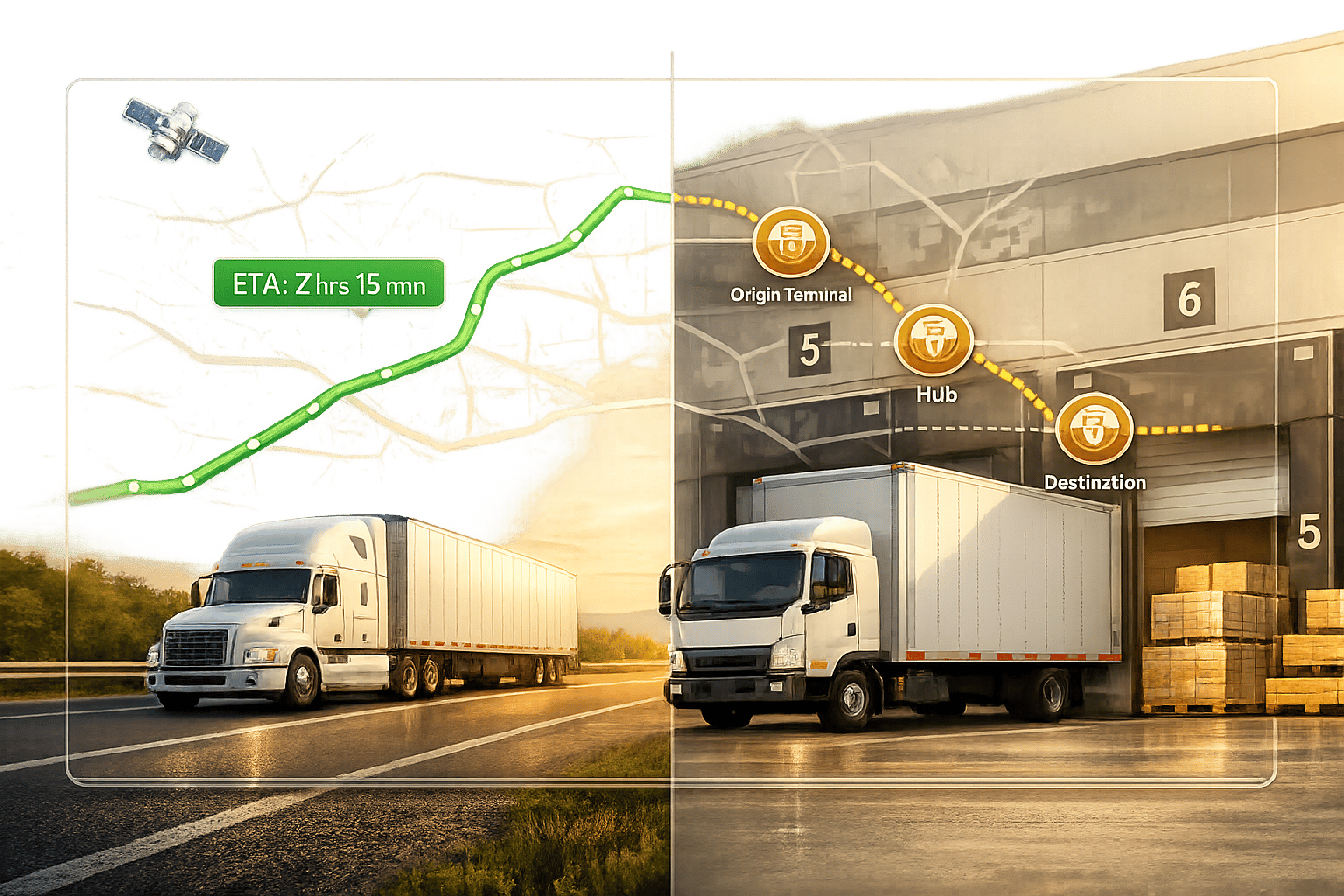
LTL (Less-Than-Truckload) and FTL (Full-Truckload) shipping serve different purposes, but both have unique challenges when it comes to visibility. Here’s what you need to know:
-
LTL Visibility:
- Operates on a hub-and-spoke system with multiple stops.
- Tracking relies on milestone updates from terminal scans.
- Gaps occur between terminals, with no GPS-level updates.
- Higher risk of delays, misrouting, or damage due to multiple handoffs.
-
FTL Visibility:
- Freight moves directly from origin to destination.
- Continuous GPS tracking via telematics and ELDs provides real-time updates.
- Minimal handling reduces risks, but rural routes and driver compliance can cause occasional issues.
Key Takeaway: FTL offers more accurate and continuous tracking, while LTL visibility faces challenges due to its multi-carrier, multi-terminal structure. Tools like ShipPeek LTL TMS help bridge these gaps by consolidating data from various carriers into a single dashboard, improving tracking and efficiency.
Quick Comparison
| Feature | LTL Visibility | FTL Visibility |
|---|---|---|
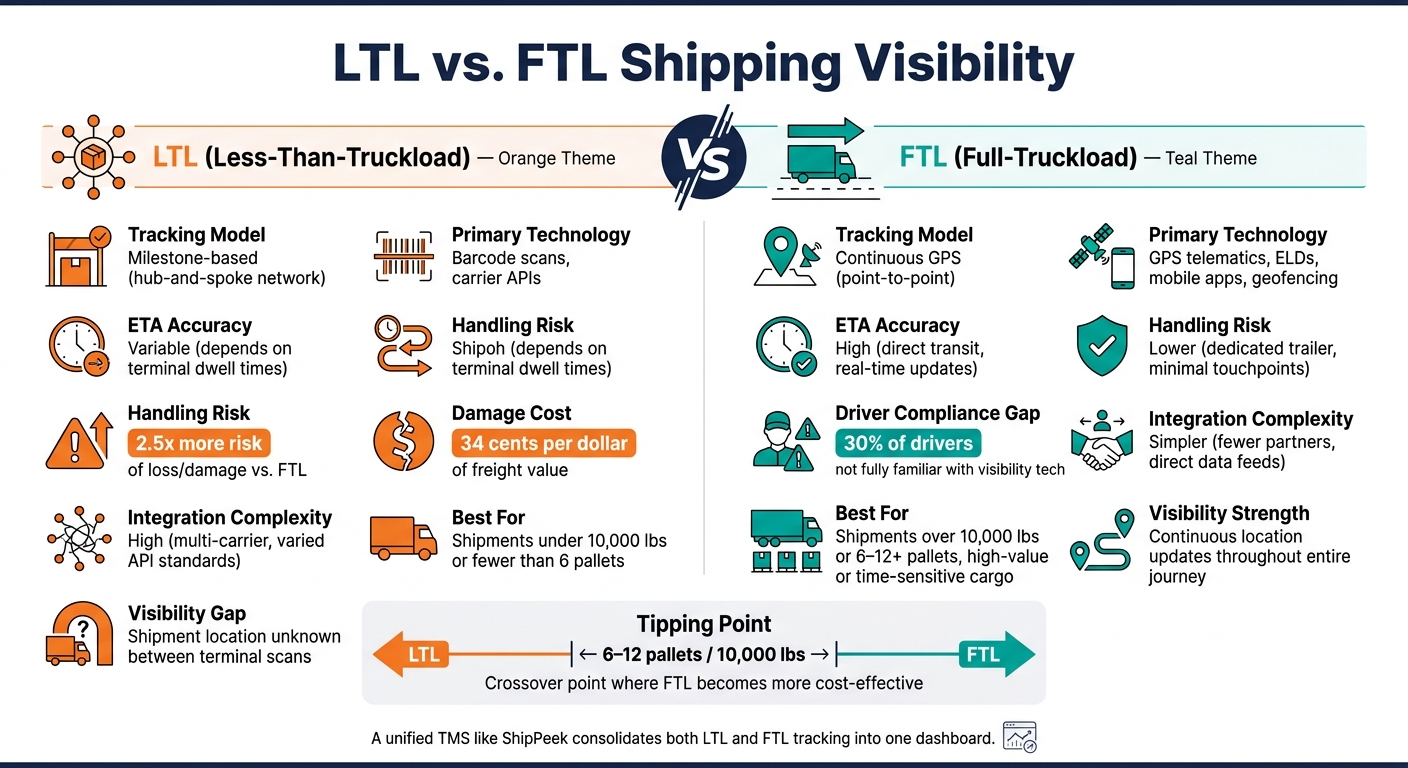
| Tracking Model | Milestone-based (hub-and-spoke) | Continuous GPS (point-to-point) |
| Technology | Barcode scans, carrier APIs | GPS, ELDs, mobile apps |
| ETA Accuracy | Variable (depends on stops) | High (direct transit) |
| Handling Risk | Higher (multiple touchpoints) | Lower (dedicated trailer) |
| Integration Needs | Complex (multi-carrier systems) | Simpler (fewer partners involved) |
When to Use:
- Choose LTL for smaller, cost-sensitive shipments under 10,000 pounds.
- Opt for FTL for large, time-sensitive, or high-value loads requiring direct transit.
ShipPeek LTL TMS simplifies managing both modes by centralizing tracking, linking shipment identifiers, and integrating with supply chain systems.
LTL Visibility: Features and Challenges
How LTL Visibility Works
LTL tracking operates on a hub-and-spoke network. Here’s how it works: freight is picked up, consolidated with other shipments at a terminal, transported to another terminal, and then broken down for final delivery. At each terminal, dock workers scan the freight to log milestone events like “Arrived at Terminal.” These scans provide status updates at specific points, but not continuous tracking. This means that between scans, the shipment’s exact location is unknown. Carrier APIs collect these milestone updates and centralize them into a unified system for easier access and monitoring.
Common Visibility Gaps in LTL
The reliance on a multi-terminal system creates noticeable blind spots. For instance, while freight moves between hubs, there are no GPS-level updates - only the next terminal scan provides an update. This process depends heavily on dock workers scanning shipments, and when scans are missed, shipment statuses can remain outdated for hours [2].
Another frequent issue is a mismatch in documentation. Carriers use a PRO number to track shipments internally, while shippers rely on their Bill of Lading (BOL) number. Without a system that connects these identifiers, checking shipment statuses often turns into a manual and time-consuming task [4]. Additionally, each handling point introduces risks like misrouting or damage, which often go unnoticed until the next terminal scan.
These gaps highlight the need for a system that unifies tracking and simplifies data management.
“On-time performance is the outcome; real-time visibility is the early-warning system.” - LoadStop [3]
Using ShipPeek LTL TMS for LTL Visibility
To address these challenges, an API-driven solution can make all the difference. ShipPeek LTL TMS bridges visibility gaps by pulling real-time status updates directly from carrier systems, reducing the reliance on terminal scans [4]. Logistics managers can use a single dashboard that consolidates data from all LTL providers, linking PRO numbers with their corresponding BOL numbers automatically. This eliminates the need for manual lookups and ensures seamless tracking.
ShipPeek also integrates rating and booking functions, streamlining visibility alongside shipment execution.
sbb-itb-8138a00
FTL Visibility: Strengths and Limitations
How FTL Visibility Works
FTL (Full Truckload) shipments are straightforward when it comes to tracking. Since the freight moves directly from origin to destination on a dedicated truck, the truck’s location essentially mirrors the shipment’s location. This eliminates complexities like terminal transfers or freight consolidation that are common in LTL (Less Than Truckload) shipping.
Tracking relies heavily on GPS telematics integrated into the truck’s on-board unit (OBU) and Electronic Logging Devices (ELDs). These devices transmit continuous location updates throughout the journey [2]. Mobile driver apps play a crucial role, logging key milestones such as dispatch details, arrival at pickup, departure, delivery arrival, and delivery completion. They also capture Proof of Delivery (POD) [3].
Some systems take this a step further with geofencing, which uses defined geographic boundaries to trigger automated alerts when a truck enters or exits a facility’s vicinity. This technology boosts ETA accuracy and streamlines dock scheduling [2][3]. For shipments that require extra care, like temperature-sensitive or high-value cargo, IoT sensors provide real-time monitoring of conditions such as temperature, humidity, and shock [2].
“In FTL environments, road shipment tracking with continuous location updates and geofenced events improves ETA accuracy, reduces detention, and supports dock, yard, and labor planning.” - Descartes [2]
Even with these advanced tools, challenges remain.
Challenges in FTL Visibility
While FTL tracking is less complex than LTL, it’s not without its difficulties. For starters, rural routes can disrupt GPS signals, creating occasional data gaps. Additionally, driver privacy concerns can hinder adoption - about 30% of drivers are not fully familiar with the visibility technology they’re expected to use [7]. When drivers fail to engage properly, key updates, including PODs, can go unrecorded.
Another issue arises with equipment swaps. If a carrier switches tractors mid-route, mapping the correct unit to the shipment in the Transportation Management System (TMS) isn’t always seamless [2][3]. Furthermore, the adoption of technology varies across carriers. While some fleets are equipped with sophisticated ELD systems, others still rely on manual check-calls, which can compromise the data quality promised by FTL’s continuous tracking model.
These hurdles highlight the importance of having a centralized platform to manage and integrate FTL data streams effectively.
Using ShipPeek LTL TMS for FTL Visibility
ShipPeek LTL TMS simplifies FTL visibility by consolidating data from ELD feeds, carrier APIs, and mobile apps into a single dashboard [2][3]. This unified system allows logistics managers to oversee both truckload and LTL movements from one platform, making it easier to manage mixed freight strategies.
In addition to visibility, ShipPeek’s carrier integrations enable automated booking and rate requests for truckload shipments. By connecting visibility and execution in one system, logistics teams can manage operations more efficiently without juggling multiple tools.
LTL vs. FTL Visibility: A Side-by-Side Comparison
Visibility Depth and Accuracy
LTL and FTL tracking methods differ significantly in how frequently they update and how reliable those updates are. FTL shipments benefit from continuous GPS tracking, which provides highly accurate ETAs. That’s because FTL shipments travel point-to-point on dedicated trucks, enabling GPS telematics and ELDs (Electronic Logging Devices) to deliver real-time location updates throughout the journey. This setup ensures more precise predictions.
LTL shipments, however, operate on a hub-and-spoke model. Updates are provided through timestamped scans when freight arrives or departs a terminal. The downside? Between terminals, shipments essentially go dark.
“Traditional systems only provide updates at major scanning points, leaving long gaps where shipment status is unknown.” - Ana Kuntz, Trackonomy [1]
These visibility gaps can lead to higher operational costs [1]. Additionally, because LTL freight involves multiple handoffs, the risk of loss or damage is 2.5 times higher than FTL. On average, damage incidents cost 34 cents per dollar of freight value [8].
| Feature | LTL Visibility | FTL Visibility |
|---|---|---|
| Tracking Model | Milestone-based via hubs | Continuous (point-to-point) |
| Primary Technology | Barcode scans, carrier APIs | GPS telematics, ELDs, mobile apps |
| ETA Precision | Variable (depends on terminal dwell times) | High (direct transit) |
| Handling Risk | Higher (multiple touchpoints) | Lower (dedicated trailer) |
Now, let’s explore how integration challenges further separate these two visibility models.
Integration Complexity
Integration is another area where LTL and FTL visibility diverge. LTL systems often involve multiple carriers, each with its own API standards, portal formats, or data structures. This variety makes it tricky to consolidate all the data into a single, unified view.
FTL visibility, on the other hand, is generally simpler to integrate. Fewer partners are involved, and data flows more seamlessly from GPS and ELD systems. The primary challenge for FTL isn’t the technology itself but ensuring drivers comply with mobile apps or onboard unit (OBU) systems [2].
Tools like ShipPeek LTL TMS simplify this process by standardizing carrier APIs. They pull data from various sources - GPS feeds, carrier portals, and EDI - into a single dashboard. This eliminates the need to log into multiple carrier systems or manually reconcile data across modes.
When to Use LTL or FTL Visibility
These technical differences directly influence when to choose one visibility method over the other. The decision often depends on shipment size, value, and risk tolerance. Here’s a quick breakdown:
- Go with FTL visibility for high-value or time-sensitive shipments. Continuous tracking and minimal handling make it the safer and more dependable option. Plus, IoT sensors for monitoring conditions like temperature and humidity tend to be more cost-efficient at the FTL level [2].
- Opt for LTL visibility for smaller shipments - typically under 10,000 pounds or fewer than six pallets - where cost is a bigger concern, and milestone-based updates are sufficient.
The tipping point between LTL and FTL often falls between 6–12 pallets or 10,000 pounds [8]. Beyond that, FTL can become more economical than paying LTL rates across multiple carriers.
“When a shipment exceeds approximately 6–12 pallets or more than 10,000 pounds, the per-unit cost can shift, making it more cost-effective to pay a flat rate for a dedicated full truckload.” - Red Stag Fulfillment [8]
For businesses that regularly use both modes - such as retail distributors handling large warehouse-to-DC runs with FTL and smaller store shipments with LTL - a unified platform capable of managing both seamlessly is the most efficient solution.
Building End-to-End Visibility Across LTL and FTL
How to Build a Unified Visibility Workflow
LTL and FTL operations generate data in different formats, making reconciliation a challenge. LTL carriers often rely on milestone-based terminal scans, while FTL carriers use continuous GPS feeds. To bring these together, normalization is key.
Start by mapping carrier-specific codes (like “DLV-INTENT” or “with courier”) to a standard set of statuses, such as In Transit, Out for Delivery, or Exception [10]. To avoid confusion when shipments cross time zones, standardize all timestamps to a single time zone - UTC is a reliable choice [10]. Additionally, implement milestone logic to flag shipments that have been inactive for 48 hours, enabling your team to step in quickly when needed [10].
Once normalized, this data can seamlessly integrate with your broader supply chain systems, creating a unified visibility workflow.
Connecting ShipPeek LTL TMS with Supply Chain Systems
ShipPeek LTL TMS simplifies supply chain connectivity through a REST API. This API pulls real-time carrier data and integrates it with platforms like Shopify, WooCommerce, or custom warehouse management systems [9].
The platform supports hybrid workflows, allowing you to manage both your fleet and third-party carriers from a single dashboard [9]. It also consolidates tracking identifiers - such as PRO numbers, BOL numbers, and shipment IDs - into a unified timeline, ensuring your team has a consistent view regardless of the carrier [11].
For those wanting to stay ahead of potential issues, ShipPeek provides dedicated exception queues. These queues highlight delays and OS&D (Over, Short, and Damaged) events before they impact customers. You can also create tiered alert systems: use instant Slack or SMS notifications for high-value order delays, while reserving email summaries for less urgent updates [10].
Steps to Get Your Visibility Solution Running
ShipPeek’s onboarding process is designed to get you up and running quickly. A 30-minute implementation call ensures your carrier accounts and workflows are tailored to your needs before going live [9]. Here’s how it typically works:
- Obtain API credentials: Sign up with ShipPeek to access their sandbox environment (api.shippeek.dev) for testing. This is usually available within 24 hours of account setup [11].
- Connect your carriers: Link to over 100 LTL carriers to instantly access contract rates and tracking milestones [9].
- Configure tracking logic: Set up webhooks to automate shipment updates, removing the need for manual API pulls. Use carrier-assigned PRO numbers as your primary tracking identifier for the most accurate event data [6][4].
- Set your alert rules: Define what shipment events will trigger alerts and assign priorities to focus on critical issues.
ShipPeek offers a 7-day free trial, with pricing starting at $999 per month. New users can take advantage of an introductory rate of $749 per month for the first three months.
Conclusion and Key Takeaways
Let’s wrap up with some key insights from the discussion on visibility challenges and the advantages of integration.
LTL (Less-than-Truckload) shipments rely heavily on milestone scans across a hub-and-spoke network, involving multiple handoffs. This can lead to higher operational costs, especially when dealing with multi-carrier shipments. On the other hand, FTL (Full Truckload) shipments benefit from continuous GPS tracking along direct routes, making them simpler to monitor. While tracking provides location updates, true visibility goes a step further - it ensures schedule compliance and flags potential issues. This proactive approach is what separates advanced logistics operations from merely reactive ones.
As FreightPOP aptly puts it:
“For most freight shippers, shipment visibility isn’t a ‘nice to have’ - it’s a necessity.” - FreightPOP [5]
A unified platform like ShipPeek LTL TMS makes managing both LTL and FTL shipments seamless. Instead of juggling multiple carrier portals or manually reconciling data, ShipPeek provides a single dashboard with access to over 100 LTL carriers, real-time tracking, and centralized data. This allows businesses to respond quickly when issues arise. Plus, with a 7-day free trial and introductory pricing starting at $749/month for the first three months, it’s easy to test the platform before committing.
Ultimately, LTL shipping requires enhanced visibility due to its multiple handling points, while FTL benefits from straightforward rate and relationship management. A unified TMS simplifies both, enabling you to manage your entire freight operation without the need for separate workflows.
FAQs
Why does LTL tracking go “dark” between terminals?
LTL tracking often faces visibility challenges, especially between terminals. This is because the hub-and-spoke model involves multiple handling points where freight is moved between terminals. Tracking relies on milestone updates - like when a shipment arrives or departs a terminal - rather than continuous, real-time updates. Unlike FTL shipments, which usually travel directly from point A to point B, LTL consolidates freight from different shippers. This consolidation process can create gaps in tracking during terminal transfers.
What causes gaps in FTL GPS tracking?
Gaps in FTL GPS tracking happen because the operating model is designed for fewer stops and limited handling. Instead of providing constant location updates, tracking usually depends on milestone events, which means updates occur less frequently during transit.
How can ShipPeek LTL TMS link my BOL and PRO numbers automatically?
ShipPeek LTL TMS simplifies your shipping operations by automatically linking BOL (Bill of Lading) and PRO numbers through shipment automation and real-time data integration. With connections to over 100 carriers, the platform takes care of critical tasks like generating BOLs, assigning PRO numbers, and linking them without any extra steps. This streamlined process eliminates the need for manual data entry, boosting efficiency during booking and dispatch.