IoT in Freight: Remote Asset Management Guide
How IoT sensors, connectivity, and TMS integration boost fleet visibility, cut downtime, and protect temperature-sensitive cargo.
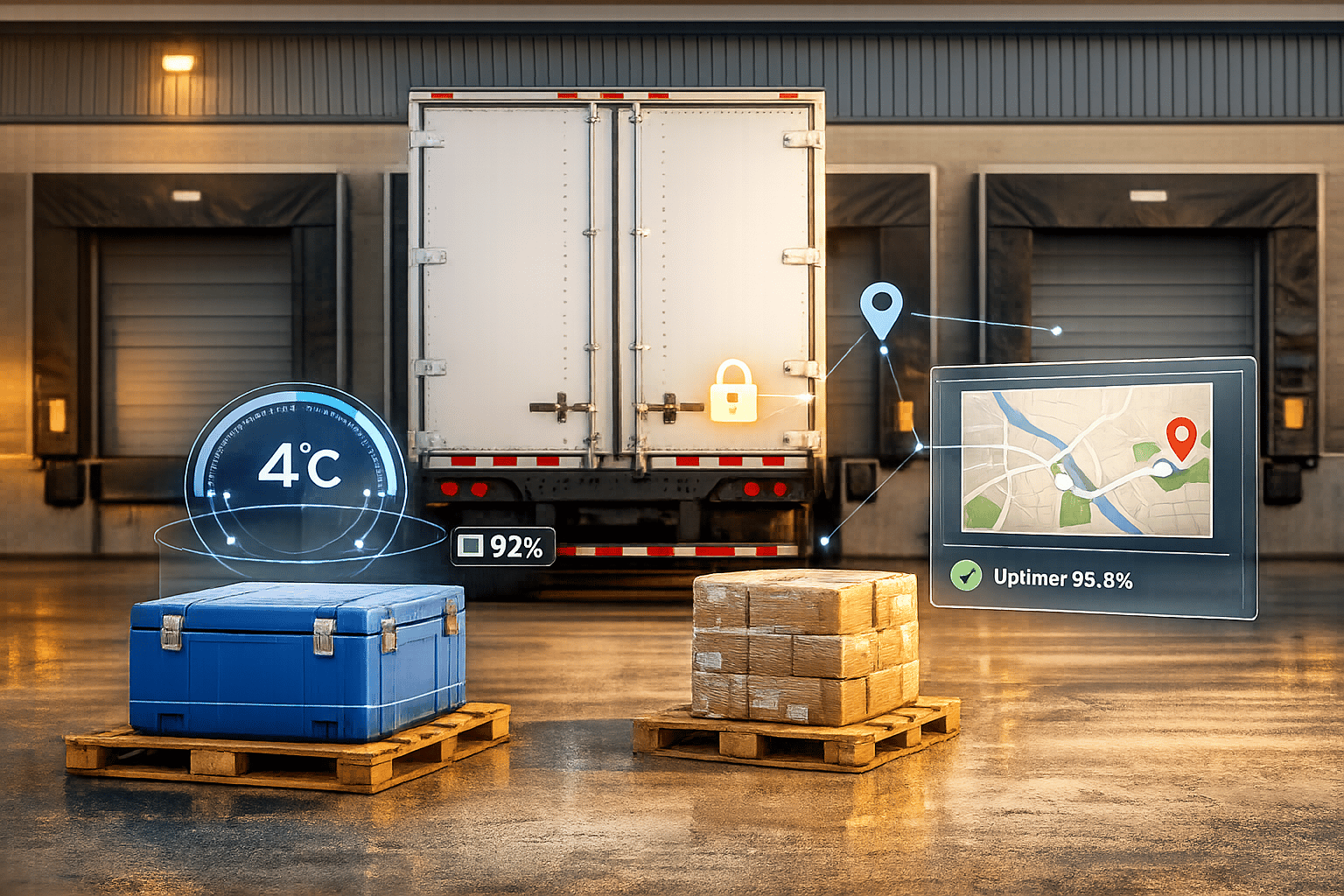
Freight logistics is changing fast, thanks to IoT. Sensors and connected devices now provide real-time updates on cargo location, condition, and performance. This means fewer delays, better cargo protection, and lower costs for operators. Here’s how IoT is transforming freight operations:
- Real-time visibility: Track trailers, containers, and cargo 24/7 with GPS and geofencing.
- Condition monitoring: Sensors alert teams to temperature or shock issues during transit, preventing spoilage or damage.
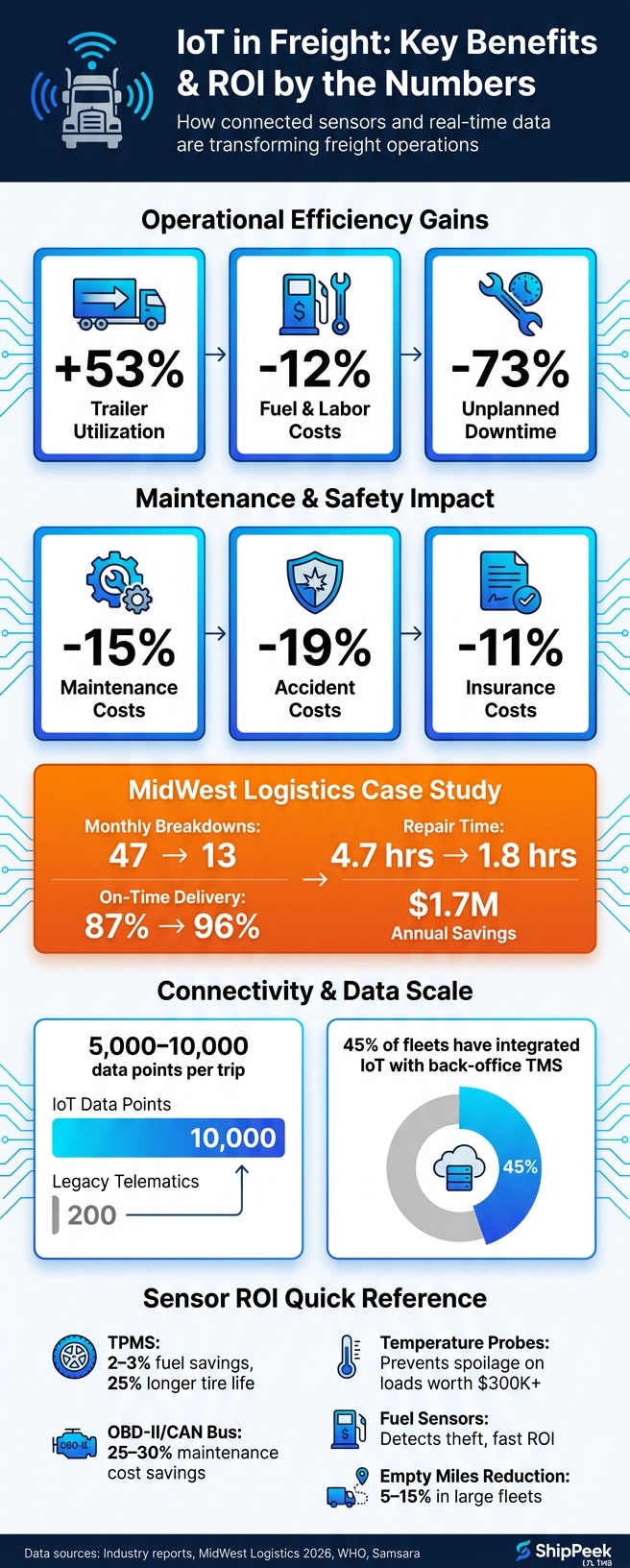
- Predictive maintenance: Engine and tire sensors help catch problems early, reducing breakdowns by up to 73%.
- Higher efficiency: IoT boosts trailer utilization by 53% and cuts fuel and labor costs by 12%.
With tools like ShipPeek LTL TMS, IoT data is centralized into one platform, simplifying decision-making and improving fleet operations. From reducing idle assets to ensuring compliance with regulations, IoT is driving smarter freight management.
How IoT Powers Fleet Management
sbb-itb-8138a00
Core Components of IoT for Remote Asset Management
A well-designed freight IoT system brings together devices, connectivity, and platforms. These elements work hand in hand to turn raw data into actionable insights. Any freight IoT setup operates on three interconnected layers: physical devices on the assets, the network transmitting the data, and the platform that processes and interprets it.
Key IoT Devices and Sensors Used in Freight
The hardware layer is where data collection begins. Different sensors serve specific purposes, and most fleets rely on a combination of these devices.
GPS and GNSS modules form the backbone of location tracking, offering real-time positioning and geofencing capabilities. Advanced units even use techniques like dead reckoning (integrating accelerometers and gyroscopes) to maintain accuracy in areas where satellite signals falter, such as tunnels or dense urban zones [6]. OBD-II and CAN bus gateways, which connect directly to a vehicle’s diagnostic port, extract engine data like RPM, coolant temperature, fuel usage, and fault codes. This data is crucial for predictive maintenance.
For safeguarding cargo, environmental sensors inside trailers monitor temperature, humidity, and gas levels. For example, the World Health Organization (WHO) mandates sensors with an accuracy of ±0.5°C to ensure the safe transport of temperature-sensitive pharmaceuticals [1]. Cargo and door sensors, using magnetic contacts and light detection, alert operators to unauthorized access or tampering. These precise tools enable proactive asset management strategies.
Other often-overlooked sensors include Tire Pressure Monitoring Systems (TPMS) and fuel level sensors. Underinflated tires, for instance, can increase fuel consumption by 2–3% and reduce tire lifespan by 25% [6]. Fuel sensors, on the other hand, track tank levels and cross-check with GPS data to detect fuel theft or card fraud, offering a quick return on investment.
| Sensor Type | Data Captured | Primary Benefit |
|---|---|---|
| OBD-II / CAN Bus | DTCs, RPM, fuel rate | Predictive maintenance; 25–30% cost savings [6] |
| Temperature Probe | Multi-zone temps | FSMA compliance; prevents spoilage [6] |
| TPMS | PSI, tire temperature | 2–3% fuel savings; blowout prevention [6] |
| Cargo / Door Sensor | Door status, load weight | Theft prevention; weight compliance [6] |
| Fuel Sensor | Real-time tank level | Detects fuel theft and card fraud [6] |
| Accelerometer | Shock, tilt, hard braking | Damage claims support; driver safety coaching [6] |
Connectivity Options for Freight IoT
Transmitting data from the asset to the cloud requires a reliable network, but no single connectivity option fits every scenario.
Cellular (LTE/5G) is the primary choice for most freight IoT applications. In North America, LTE Cat M1 is favored for its low power usage and 5G compatibility, while LTE Cat 1 supports higher data rates for applications like video telematics. However, around 14% of the U.S. lacks reliable 4G LTE coverage [6], posing challenges for rural routes or cross-border operations. In these cases, satellite connectivity provides global coverage. While more expensive and slower, it’s indispensable for remote areas or sea routes.
At yards and terminals, short-range protocols take over. Bluetooth Low Energy (BLE) connects devices like tire sensors and temperature probes to a central gateway without draining batteries. Meanwhile, LPWAN technologies such as NB-IoT and LoRaWAN excel for stationary or slow-moving assets, like trailers parked at depots, where sensors need to last months on a single battery.
The most robust setups use a hybrid approach, combining multi-network SIMs or eSIMs that switch between carriers with “store-and-forward” technology. This buffers data locally when connectivity drops and uploads it once the signal is restored. Such systems are especially valuable for international shipments, where networks change at each border.
IoT Platforms and Data Management
Once data is reliably transmitted, it’s up to IoT platforms to make it actionable. These cloud-based systems organize sensor data, present it through dashboards, and trigger automated alerts or workflows.
“If you’re evaluating IoT fleet management, your success depends less on devices and more on data flow, integrations, and security controls.” - Gene Whaley, Keystone Corp [7]
The integration capabilities of a platform are critical. Without stable APIs to connect with systems like Transportation Management Systems (TMS), WMS, or ERP, teams may resort to manual data entry, undermining the efficiency IoT is meant to deliver. A good example is C.H. Robinson’s “Drop Trailer Plus” Asset Management System, launched in 2025. Integrated into the Navisphere platform, it combines GPS and real-time operational data to offer detailed trailer visibility, whether assets are moving or stationary [3].
Beyond data organization, platforms also handle device lifecycle management. This includes pushing firmware updates over the air (FOTA), monitoring connectivity health, and applying security patches without requiring physical access to the device. On the security front, features like Multi-Factor Authentication (MFA), role-based access control (RBAC), and encrypted data pathways are essential to protect sensitive cargo and route information.
A fully connected IoT-equipped vehicle can generate 5,000–10,000 data points per trip, compared to just 100–200 from older telematics systems [6]. To manage this volume effectively, platforms need to establish clear alert priorities. For example, separating critical issues like engine failures from less urgent warnings such as slow tire leaks ensures dispatchers can focus on what matters most without being overwhelmed.
Practical Use Cases of IoT in Freight Operations
Building on key IoT technologies, these examples highlight how IoT is reshaping freight operations in tangible ways.
Real-Time Asset Tracking and Utilization
Real-time tracking provides instant visibility into the location of trucks and trailers. Using GPS modules and geofencing, fleet managers can monitor assets in transit or at rest in a yard. This level of visibility allows facilities to pre-assign dock doors and minimize congestion.
IoT also helps identify underutilized assets. For instance, a trailer sitting idle at a shipper’s dock for three days might go unnoticed without continuous tracking. With IoT, fleet managers can spot these inefficiencies, taking action before they escalate. This approach has been shown to reduce empty miles by 5–15% in large fleets[5].
“The most effective freight networks will be those that treat visibility and intelligence as shared capabilities rather than siloed tools.” - Johannes Forster, Managing Director of IoT Solutions, Giesecke+Devrient[4]
This level of tracking not only improves asset utilization but also enables proactive steps to protect cargo, as discussed below.
Condition Monitoring for Sensitive Cargo
For temperature-sensitive shipments, the stakes are incredibly high. A single load of pharmaceuticals or perishables can be worth over $300,000[3]. In fact, food and beverage shipments accounted for 22% of global cargo theft incidents in 2024[1]. IoT sensors capable of monitoring temperature, humidity, oxygen/carbon dioxide levels, light exposure, and shock provide carriers with the tools to act before damage occurs.
This kind of monitoring replaces outdated methods like manual data loggers, which only reveal issues after the fact. IoT-enabled systems send real-time alerts via SMS or email if conditions deviate from set parameters. This allows drivers or dispatchers to address problems immediately. Cash-Wa Distributing, a food service company, experienced a transformation after adopting wireless temperature monitoring:
“With Samsara’s always-on wireless temperature monitoring, we can show that we’ve taken great care of the product every step of the way. We’re confident we’re compliant, and we’re winning more business.” - Chad Henning, Co-President, Cash-Wa Distributing[9]
By ensuring constant monitoring, IoT helps carriers maintain product quality and compliance, which can directly impact customer trust and business growth.
Preventive Maintenance and Remote Diagnostics
Unplanned breakdowns not only cost money but also damage customer relationships. IoT shifts maintenance from reactive to predictive, using sensors to detect potential issues before they result in costly failures.
A 2026 case study highlights how U.S.-based carrier MidWest Logistics adopted an AI-powered predictive maintenance system. By integrating hundreds of IoT sensors with a cloud platform, the company saw impressive results: monthly breakdowns dropped from 47 to 13, unplanned downtime decreased by 73%, and average repair times were reduced from 4.7 to 1.8 hours. These improvements saved the company approximately $1.7 million annually[10].
“Predictive analytics also play a growing role in maintenance and asset readiness. By correlating movement, shock, temperature, and usage data, AI systems can anticipate maintenance needs and reduce unplanned downtime.” - Johannes Forster, Managing Director of IoT Solutions, Giesecke+Devrient[4]
IoT sensors monitoring key systems like engines, brakes, and oil quality enable fleet managers to schedule maintenance before small problems turn into major failures. This predictive capability enhances reliability and keeps operations running smoothly.
Integrating IoT with ShipPeek LTL TMS
The power of IoT lies in transforming raw data into actionable freight decisions, all from a single platform. By connecting IoT devices to a transportation management system (TMS) like ShipPeek, this process becomes much more streamlined.
How ShipPeek Handles IoT Data
ShipPeek’s logistics API seamlessly integrates with over 100 LTL carriers, bringing live tracking data, rates, and booking confirmations into one unified dashboard [11]. This eliminates the need to switch between multiple portals. Every status update - whether it’s a pickup confirmation or final delivery - appears on a single operational timeline.
This is especially important for IoT integration, as sensor data and carrier milestones need to coexist in one place to be useful. For instance, when a GPS unit logs a trailer as “Arrived at Pickup” or a telematics system detects a route deviation, ShipPeek automatically records these updates - no manual input required [13][7]. Consolidating this data into one platform paves the way for operational improvements.
Benefits of Combining IoT and ShipPeek
Integrating IoT with ShipPeek delivers measurable improvements in cost management and efficiency. Fleets using GPS tracking and IoT data have reported an average 8% reduction in labor costs, while IoT-driven integrations have improved operational efficiency by 15–25% [7]. Additionally, ShipPeek’s direct carrier API integration has reduced billing discrepancies by 15–30% [11].
“On-time performance is the outcome; real-time visibility is the early-warning system.” - LoadStop [13]
These advantages also enhance remote asset management by minimizing manual tasks and enabling quicker responses to real-time issues. Beyond cost savings, ShipPeek’s exception queue allows teams to identify delays, lane trends, and carrier utilization problems as they happen - without needing a driver’s call or waiting for an EDI update.
On top of these benefits, specific workflows powered by IoT add even more value to day-to-day operations.
IoT-Enabled Workflows Inside ShipPeek
Two workflows stand out as especially effective. First, geofencing for yard management: when a truck crosses a geofence near a warehouse, ShipPeek can automatically alert dock staff about its arrival. This gives the team time to assign a dock door and prepare labor, reducing congestion and improving overall yard efficiency [13][7].
Second, condition-based exception alerts: leveraging IoT sensors for cold chain monitoring, ShipPeek can generate alerts the moment temperature readings go out of range [12][14]. Instead of discovering temperature issues after delivery, dispatchers are notified during transit - when corrective action is still possible. Currently, around 45% of fleets have integrated their management software with back-office systems like a TMS [7].
Steps to Implement IoT for Remote Asset Management
Assessing Readiness and Setting Goals
Before diving into IoT solutions, start by pinpointing operational pain points like unpredictable transit delays, long dock wait times, or manual handling of exceptions. These issues will guide the entire process [5].
Next, evaluate your current systems to see if they can integrate with IoT data streams. Can your platforms handle incoming IoT data directly, or will you need middleware? Also, identify connectivity challenges, especially in rural or cross-border areas, where alternatives like LPWAN or satellite may be necessary [2][15]. Addressing these factors upfront can save you from expensive headaches during implementation.
With your constraints in mind, set 2–3 specific KPIs to measure success. Examples include improving ETA accuracy, boosting on-time delivery rates, reducing fuel consumption, or cutting down on unplanned equipment downtime. Avoid vague goals like “better visibility”, which make it tough to measure ROI. These KPIs will serve as benchmarks for evaluating progress during the pilot phase.
Piloting and Scaling IoT Solutions
Once your objectives are clear, test your IoT strategy in a controlled environment. A 60–90 day pilot on a few routes or a single depot is a good starting point to assess both technical feasibility and business impact [10].
Assign a dedicated person to act on the pilot’s data. If dispatchers and drivers don’t adjust their actions based on system alerts, the pilot won’t deliver meaningful results [10].
Set clear success metrics before you begin. For instance, aim for ETA accuracy within ±15 minutes by week six. Test multiple hardware vendors during the pilot to avoid locking into a single supplier before determining which sensors work best for your needs [8][10]. If the pilot doesn’t meet its ROI goals, don’t scrap everything. Instead, retain the data infrastructure for future use cases:
“If the pilot misses payback, keep the data pipes and cut the rest. You’ll reuse telemetry in the next use case.” - SumatoSoft [10]
The data ingestion systems you build will likely serve other applications down the line. Once the pilot proves successful, scale up in phases. In Phase 2 (months 3–9), integrate devices with your TMS and automate alerts. By Phase 3 (months 9–24), you can expand into predictive maintenance and carrier performance scoring [5].
Best Practices for Data and Alert Management
After validating your IoT system, focus on managing alerts effectively to avoid overwhelming your team. Too much data can lead to alert fatigue, which reduces decision-making quality. The fix? Automate responses for low-risk scenarios, like sending arrival notifications when a truck crosses a geofence. Reserve human intervention for high-risk issues such as temperature excursions or unauthorized movements [8].
“The goal is fewer, better alerts, not more noise. When you automate the right tasks, you reduce manual check calls and streamline coordination.” - Keystone Technology Consultants [7]
Ensure someone is responsible for data quality. If discrepancies arise - like conflicting delivery timestamps between your TMS and IoT platform - there should be a clear process for resolving them [7]. Build a flexible backend that can adapt to changes, such as new sensor types or firmware updates, to avoid system failures caused by rigid architecture [8].
On the security side, keep sensor data streams separate from your core ERP traffic. Implement multi-factor authentication and role-based access controls to safeguard sensitive information [7]. Lastly, confirm that your IoT vendor supports exporting both raw event logs and aggregated metrics. This ensures data portability and protects you from vendor lock-in [7].
Conclusion and Business Impact
Key Benefits of IoT-Enabled Freight Management
Integrating IoT into freight operations is a game-changer, delivering measurable financial and operational improvements. Take MidWest Logistics, for example - a U.S.-based carrier that reduced unplanned downtime by 73% and saved around $1.7 million annually after rolling out AI-driven IoT sensors across its fleet. Their on-time delivery rate also jumped from 87% to 96% [10]. These aren’t just small improvements; they’re major shifts in efficiency and profitability.
One standout advantage of IoT is uncovering hidden capacity. For instance, boosting trailer utilization from 60% to 70% across a fleet of 200 trailers effectively adds the equivalent of 20 extra trailers - without buying any new equipment. IoT makes this possible by providing real-time insights into underutilized assets.
| Benefit Category | Measured Impact |
|---|---|
| Fuel & Labor | -12% |
| Maintenance | -15% |
| Insurance | -11% |
| Accident Costs | -19% |
| Utilization | +53% |
| Downtime | -73% [3][10] |
These results show the tangible value IoT brings to freight management, especially when paired with tools like ShipPeek LTL TMS.
How ShipPeek LTL TMS Complements IoT
ShipPeek LTL TMS takes IoT’s raw data and turns it into actionable insights, driving smarter, automated decisions. Without a platform like ShipPeek, sensor data - such as location updates, temperature readings, or dwell-time alerts - can be overwhelming. But when this data feeds directly into ShipPeek, it transforms how dispatchers work. Instead of chasing updates, they can respond instantly and automatically.
“Real-time visibility across both our own and our strategic contract carriers’ fleets enables us to monitor each trailer exactly, whether at rest or in motion.” - Adam McDonough, VP of Truckload and Intermodal, C.H. Robinson [3]
ShipPeek’s logistics API connects with multiple carriers, consolidating rate requests, bookings, and tracking into one streamlined platform. When IoT data integrates seamlessly, it powers features like automated exception management. For example:
- Geofence breaches trigger detention alerts.
- Temperature fluctuations flag cold-chain issues.
- Idle assets are identified for immediate redeployment.
This automation reduces manual check-ins, speeds up responses, and ensures decisions are based on accurate, real-time data - not guesswork. The combination of IoT and ShipPeek LTL TMS showcases how technology can reshape freight operations, making them more efficient, responsive, and data-driven.
FAQs
What IoT sensors should I start with for freight asset management?
IoT sensors are a game-changer for freight companies, offering real-time visibility and monitoring capabilities. Some key tools to consider include: - GPS trackers: Keep tabs on location and movement, ensuring assets are where they need to be. - Temperature sensors: Protect cargo by maintaining safe conditions, especially for perishable goods. - Humidity sensors: Safeguard sensitive items that require specific moisture levels. These sensors do more than just monitor - they actively help reduce spoilage, prevent theft, and minimize claims. Plus, they ensure assets are being used efficiently. By integrating these core tools, freight companies can make smarter decisions and streamline operations with data that truly matters.
How do I handle IoT tracking when routes lose cellular coverage?
IoT tracking systems can stay operational even during cellular outages by utilizing alternative communication technologies such as GPS, RFID, Bluetooth, or satellite connectivity. Many tracking devices are equipped to store data locally, allowing them to transmit the information once a connection is re-established. Additionally, some systems feature dual-mode communication, enabling them to automatically switch to satellite or Bluetooth when cellular signals are unavailable. This ensures continuous asset tracking, even in remote locations or areas with weak signal coverage.
How can I integrate IoT data into ShipPeek LTL TMS without alert overload?
When incorporating IoT data into ShipPeek LTL TMS, managing alerts effectively is key to avoiding overload. Focus on filtering and prioritizing data to keep notifications meaningful. Start by setting threshold-based alerts to highlight critical deviations. Use data filtering and aggregation to cut down on unnecessary notifications, and categorize alerts by their severity to ensure the most urgent ones get immediate attention. Regularly review and fine-tune these settings to maintain a balanced flow of updates. This way, you’ll stay informed about vital changes without being swamped by excessive alerts.