How Freight Class Impacts LTL Shipping Costs
Accurate freight class determines LTL costs—measure density, use NMFC codes and TMS tools to avoid costly re-rates.
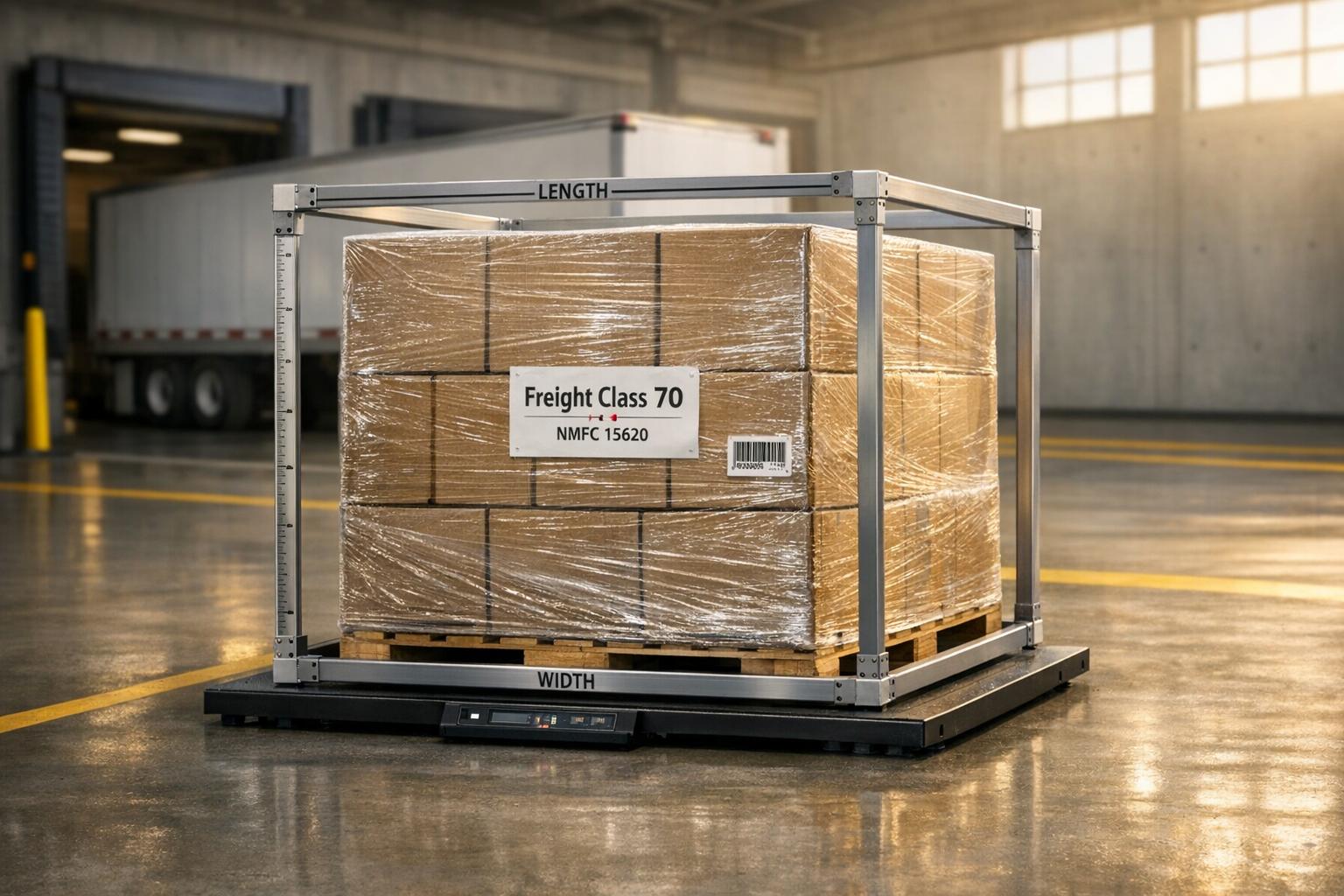
Freight class is a critical factor in determining Less-Than-Truckload (LTL) shipping costs. It categorizes goods based on density, stowability, handling, and liability, with classes ranging from 50 (lowest cost) to 500 (highest cost). Misclassifications can lead to significant cost increases - up to 30% per shipment - and unexpected fees like reclassification and reweigh charges. Accurate weight, dimensions, and proper NMFC codes are essential to avoid these issues. Tools like automated measurement systems and Transportation Management Systems (TMS) can help reduce errors, saving shippers thousands annually.
What is LTL freight class and Why Does it affect your shipping rates?
sbb-itb-8138a00
How Freight Class Is Determined
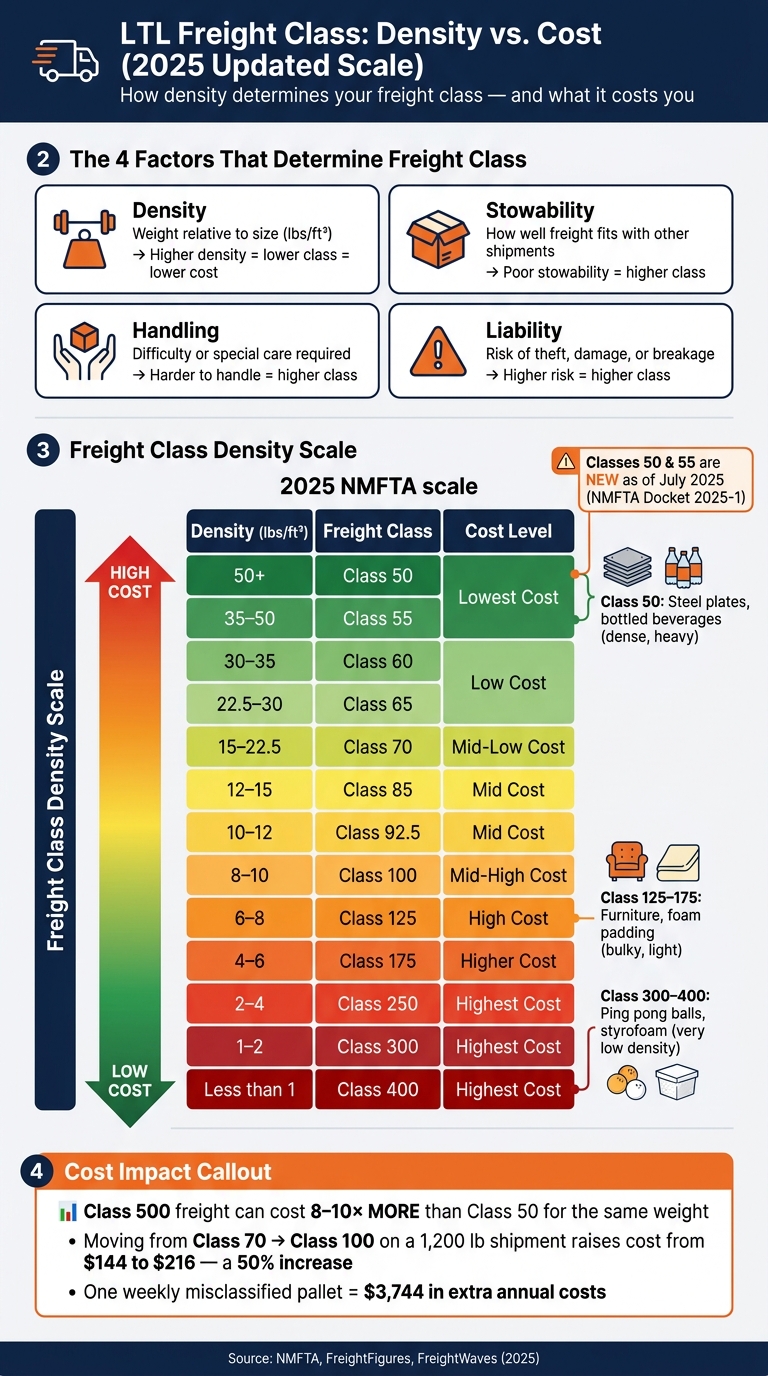
Freight class is based on a standardized set of criteria that carriers use to assess the cost and complexity of transporting an item in a shared trailer. Knowing how these criteria work can help you avoid costly misclassifications.
The 4 Factors That Define Freight Class
Freight class is determined by four main factors:
| Factor | What It Measures | Effect on Class |
|---|---|---|
| Density | Weight relative to size (lbs/ft³) | Higher density = lower class, lower cost |
| Stowability | How well the freight fits with other shipments (stackability, hazardous rules) | Poor stowability = higher class |
| Handling | Difficulty or special care required to move the freight | Harder to handle = higher class |
| Liability | Risk of theft, damage, or breakage based on the item’s value | Higher risk = higher class |
Density often carries the most weight in determining freight class. To calculate it, measure the shipment’s dimensions in inches, convert to cubic feet by dividing the volume by 1,728, and then divide the weight by that number. For example, dense items like steel plates or bottled beverages are assigned lower classes, while bulkier, lighter items like foam padding or furniture fall into higher classes.
For shipments that occupy over 750 cubic feet with a density below 6 lbs/ft³, carriers impose a cubic capacity rule. This rule assigns a minimum density of 6 lbs/ft³ and places the shipment in Class 125 or 150 [3].
How NMFC Codes Work
The National Motor Freight Classification (NMFC) system, managed by the National Motor Freight Traffic Association (NMFTA), assigns unique codes to thousands of commodities. These codes help carriers determine a commodity’s freight class and shipping rate.
If an NMFC code exists for your item, it overrides the general density-based classification [4]. The NMFTA maintains these codes in a subscription-based database called ClassIT. When completing a Bill of Lading (BOL), always include the correct NMFC code and class. Avoid using vague descriptions like “machinery”, as they can trigger carrier inspections and disputes.
The Freight Class Numbering System: Class 50 to Class 500
Freight classes range from Class 50 to Class 500. Lower numbers mean lower shipping costs, while higher numbers indicate higher costs due to factors like bulkiness or special handling requirements.
“Freight class is the single biggest factor determining your shipping costs. It is the classification system that tells carriers how to price your shipment - and understanding it can mean the difference between paying $200 or $2,000 for the same pallet.” - FreightFigures Editorial Team [2]
In July 2025, the NMFTA expanded its density scale from 11 tiers to 13 tiers, introducing Classes 50 and 55 for extremely dense commodities [3]. Here’s the updated scale:
| Density (lbs/ft³) | Freight Class |
|---|---|
| Less than 1 | 400 |
| 1 but less than 2 | 300 |
| 2 but less than 4 | 250 |
| 4 but less than 6 | 175 |
| 6 but less than 8 | 125 |
| 8 but less than 10 | 100 |
| 10 but less than 12 | 92.5 |
| 12 but less than 15 | 85 |
| 15 but less than 22.5 | 70 |
| 22.5 but less than 30 | 65 |
| 30 but less than 35 | 60 |
| 35 but less than 50 | 55 |
| 50+ | 50 |
Note: Classes 77.5, 110, 150, 200, and 500 exist but are not part of this density-based scale [3].
Shipping costs can vary dramatically across classes. For instance, rates for Class 500 freight can be 8 to 10 times higher than Class 50 rates for the same weight [2]. This classification system is essential for managing Less Than Truckload (LTL) shipping expenses and avoiding unexpected charges.
The Cost Risks of Incorrect Freight Classification
Misclassifying your freight can take a serious toll on your budget. For mid-size shippers handling 50–200 LTL shipments a week, these errors can lead to avoidable costs amounting to 5–10% of annual freight expenses [5]. For larger operations, the impact is even steeper, with losses exceeding $50,000 per year [2].
Reclassification and Unexpected Charges
Carriers routinely inspect shipments during transit. If the density or commodity description on your Bill of Lading doesn’t align with what’s on the trailer, carriers will reclassify the shipment - often at a higher rate.
But the extra costs don’t stop there. A reweigh fee, typically $25–$50 per occurrence, is added when the declared weight doesn’t match the carrier’s scale. For freight with low density that occupies more trailer space than its weight suggests, you could face deficit weight pricing, where the carrier charges as if the shipment weighed more.
| Charge Type | Cause | Financial Impact |
|---|---|---|
| Reclassification Fee | Incorrect NMFC code or density | Higher rate + flat penalty fee |
| Reweigh Fee | Declared weight vs. actual weight mismatch | $25–$50+ per occurrence |
| Deficit Weight | Low density taking up excess space | Charged at a higher weight bracket than actual |
| Accessorials | Unforeseen handling needs (e.g., liftgate) | Variable fees based on the service |
Even a small classification mistake can have a big financial impact. For example, moving a 1,200 lb shipment from Class 70 to Class 100 raises the cost from $144 to $216, a 50% increase [2]. If your company ships just one pallet weekly with this error, that’s an extra $3,744 annually [2]. These increased fees often lead to billing disputes, which only add to operational headaches.
Billing Disputes and Inspection Fees
When a carrier reclassifies your freight, you’re left with two options: pay the higher bill or dispute it. Disputes consume time and resources - gathering documentation, contacting carriers, and waiting for resolutions - all of which add to your financial strain.
“Misclassifying even one shipment can trigger reclassification fees, billing disputes, and strained carrier relationships.” - FreightFigures Editorial Team [2]
The 2026 shipping landscape adds more pressure. Major carriers have implemented general rate increases (GRIs) of 4.9–5.9% [5], and they’re showing “zero appetite” for absorbing classification errors [5]. Companies like Old Dominion and Saia are strictly enforcing these standards to protect their margins, making disputes harder to win and more likely to escalate.
Effects on Operations and Customer Satisfaction
The consequences of misclassification extend beyond fees. Carrier inspections can delay shipments, while surprise billing disrupts cash flow and complicates financial planning. Worse, when unexpected charges are passed on to customers or shipments arrive late, it damages trust.
Over time, the gap between quoted and actual shipping costs undermines your credibility with customers who count on consistent and predictable pricing.
How to Optimize Freight Class and Cut Costs
Avoidable mistakes in freight classification can lead to re-rates and unexpected charges, but with the right strategies and tools, shippers can bring more consistency and control to their LTL shipping expenses.
Standardize How You Measure and Record Freight Data
Since the NMFTA’s Docket 2025-1 update (effective July 2025), density now determines freight classification for the majority of LTL shipments - about 70–80% [1]. This means that accurate weight and dimensions are critical for calculating costs. Training dock staff to properly measure and record the outer dimensions of each shipment is a must. Ensure this data is entered digitally into the Bill of Lading to avoid errors.
“The precise weight and cubic dimensions of every pallet are now the primary drivers of freight class (and by extension, cost).” - Matt Herr, Content Developer, FreightWaves [1]
Investing in tools like certified digital scales can improve accuracy. For high-volume operations, consider an automated measuring system. For example, Douglas Dynamics - a manufacturer of work truck attachments - discovered that 25% of their shipments had incorrect data before implementing automated measuring in late 2024. After adopting the system, their re-rate frequency dropped from 25% to just 1% [1].
Once measurement consistency is achieved, the next focus should be on packaging improvements.
Improve Packaging and Palletization
Better packaging doesn’t just protect your goods - it also directly impacts freight costs. With density being a primary factor in classification, increasing shipment density can move your freight into a lower-cost class.
Here are some practical tips:
- Use cartons that fit your products snugly to eliminate wasted space.
- Aim for pallet heights between 48–52 inches to maximize density while keeping loads stackable.
- Consolidate loads with shrink-wrap to ensure accurate carrier dimensioning.
For items like furniture or machinery, shipping them “knocked-down” (disassembled) can reduce their volume by 40–60%, which may significantly lower their freight class [2]. Similarly, custom crating can cut cubic footage by 20–30%, often dropping shipments into a lower class. Uniformly shaped and stackable items also help avoid penalties for higher classifications.
Use Technology to Validate Freight Class
Billing discrepancies affect 15–30% of LTL shipments due to estimated rates [6]. Tools like ShipPeek LTL TMS can eliminate these surprises by pulling live contract rates directly from carrier APIs, ensuring the quoted rate matches the final bill.
“Estimated shipping rates cause 15–30% billing discrepancies on LTL shipments. ShipPeek retrieves live contract rates during checkout, eliminating billing surprises.” - ShipPeek [6]
Beyond rate accuracy, a Transportation Management System (TMS) provides insights into re-rate trends, helping you identify specific products or facilities that are prone to classification errors. Shippers using multi-carrier TMS platforms often reduce freight costs by 8–15% through better rate visibility and increased carrier competition.
ShipPeek LTL TMS offers a 7-day free trial, with plans starting at $999 per month. For a limited time, new users can get a discounted rate of $749 per month for the first three months.
Building Freight Class Optimization Into Your LTL Workflow
Managing Freight Class Across the Shipping Lifecycle
Freight class accuracy should be a priority at every stage of the shipping process. Catching errors before shipments leave your dock can save you from costly carrier re-rates later.
Here’s a quick look at common error points and how to address them:
| Lifecycle Stage | Best Practice |
|---|---|
| SKU Setup | Calculate the density of each SKU and identify NMFC codes that override density (e.g., for hazardous materials). |
| Packaging | Use appropriately sized cartons to reduce “shipped air” and vacuum-seal compressible items. |
| Dock Operations | Take precise measurements, including the outermost edges of shrink-wrap. |
| Documentation | Create a digital Bill of Lading (BOL) with exact weight and dimensions to avoid manual entry errors. |
| Post-Shipment | Audit carrier invoices for re-classifications and track the financial impact of each mistake. |
Detailed SKU-level data is critical, especially since updates to NMFTA standards now affect up to 25% of shipments [1].
“Accuracy and transparency have a significant impact on P&L. Shippers who invest in better data practices are seeing immediate returns: tighter cost forecasting, faster transit times, [and] stronger carrier partnerships.” - Matt Herr, FreightWaves [1]
By following this structured approach, you’ll be better prepared to incorporate technology into your workflow, as explained below.
How ShipPeek LTL TMS Supports Freight Class Optimization
A modern Transportation Management System (TMS) like ShipPeek LTL TMS does more than just provide rate quotes - it helps you identify and fix classification errors. ShipPeek connects directly to carrier APIs, pulling live contract rates to ensure your quoted price matches the correct freight class. By automating rate verification, it minimizes unexpected freight costs and eliminates guesswork, reducing billing surprises.
ShipPeek also tracks re-rate trends across your shipping history. This feature helps pinpoint the SKUs, facilities, or carriers most responsible for classification errors. For example, Bestorq, an industrial equipment supplier, discovered a 25% re-classification rate using ShipPeek. Armed with this data, they built a reliable baseline for negotiating with carriers.
KPIs to Track Classification Performance
Once you’ve optimized your workflow, use targeted KPIs to measure success. Focus on these three metrics:
- Reclassification Rate: Track the percentage of shipments reclassified by carriers. A high rate might signal issues with your measurement or documentation processes.
- Cost per Classification Error: A single class change can increase per-shipment costs by 15–30% [2]. Even small improvements can result in significant savings, with high-volume shippers potentially saving $50,000 or more annually [2].
- Dispute Resolution Time: Measure the time and resources spent resolving billing disputes to understand the operational impact of classification errors fully.
These KPIs not only highlight cost savings but also emphasize the importance of preventing errors upfront. Companies with clean, consistent data - like ULINE, which maintained high accuracy and negotiated accessorial fees into an annual flat rate - are in a stronger position to secure better shipping terms [1].
Conclusion: Accurate Freight Classification Leads to Lower LTL Costs
Freight class is a major factor in determining your shipping costs. Even a single-class mistake can increase costs by 15–30% [2]. With the LTL rate-per-pound index rising 280 basis points year-over-year as of 2025 [1], minimizing errors is more important than ever.
Accurate freight classification hinges on precise measurements, thoughtful packaging, and proper validation. Take Douglas Dynamics as an example - they cut their re-rate frequency from 25% to just 1% and recouped costs in a matter of months [1].
Since density now determines the majority of LTL classifications [1], getting weight and cubic measurements right is critical. Shippers who rely on estimates or outdated data risk re-rates on about 25% of their shipments [1].
Tools like ShipPeek LTL TMS simplify the process by automating density calculations and flagging potential classification issues before they hit your invoice. This kind of visibility doesn’t just prevent costly surprises - it can save you over $50,000 annually [2].
FAQs
How do I calculate my shipment’s freight density?
To figure out freight density, start by measuring the length, width, and height of your shipment in inches, making sure to include any pallets or packaging. Multiply these dimensions to calculate the total cubic inches. Next, divide that number by 1,728 to convert it into cubic feet. Once you have the volume in cubic feet, weigh your shipment in pounds. Divide the weight by the cubic feet to determine the density in pounds per cubic foot (lbs/ft³). This density is crucial for identifying the freight class according to NMFC guidelines. Generally, higher density corresponds to lower shipping costs.
When does an NMFC code override density-based class?
When it comes to certain commodities, an NMFC code can take priority over density-based freight classifications. This happens when specific items are assigned a fixed freight class due to their unique characteristics. For instance, goods like metal nuts and bolts or gold flakes have predetermined freight classes that remain constant, no matter their density. This approach helps maintain consistency in how these items are categorized for shipping.
What proof do I need to dispute a reclassification charge?
To challenge a reclassification charge, start by obtaining the carrier's inspection photos and measurements. Cross-check these with your own records and photographs to identify discrepancies. Then, file a formal dispute, making sure to reference the exact NMFC item number. Include all supporting documents to strengthen your case. Remember to submit everything within the carrier's 30–60 day dispute window.