Not All Accessorials Are the Same - The Right Choice Could Save You Thousands
Which LTL accessorials add the most cost, how to avoid reclassification and surprise fees, and steps to cut freight spend.
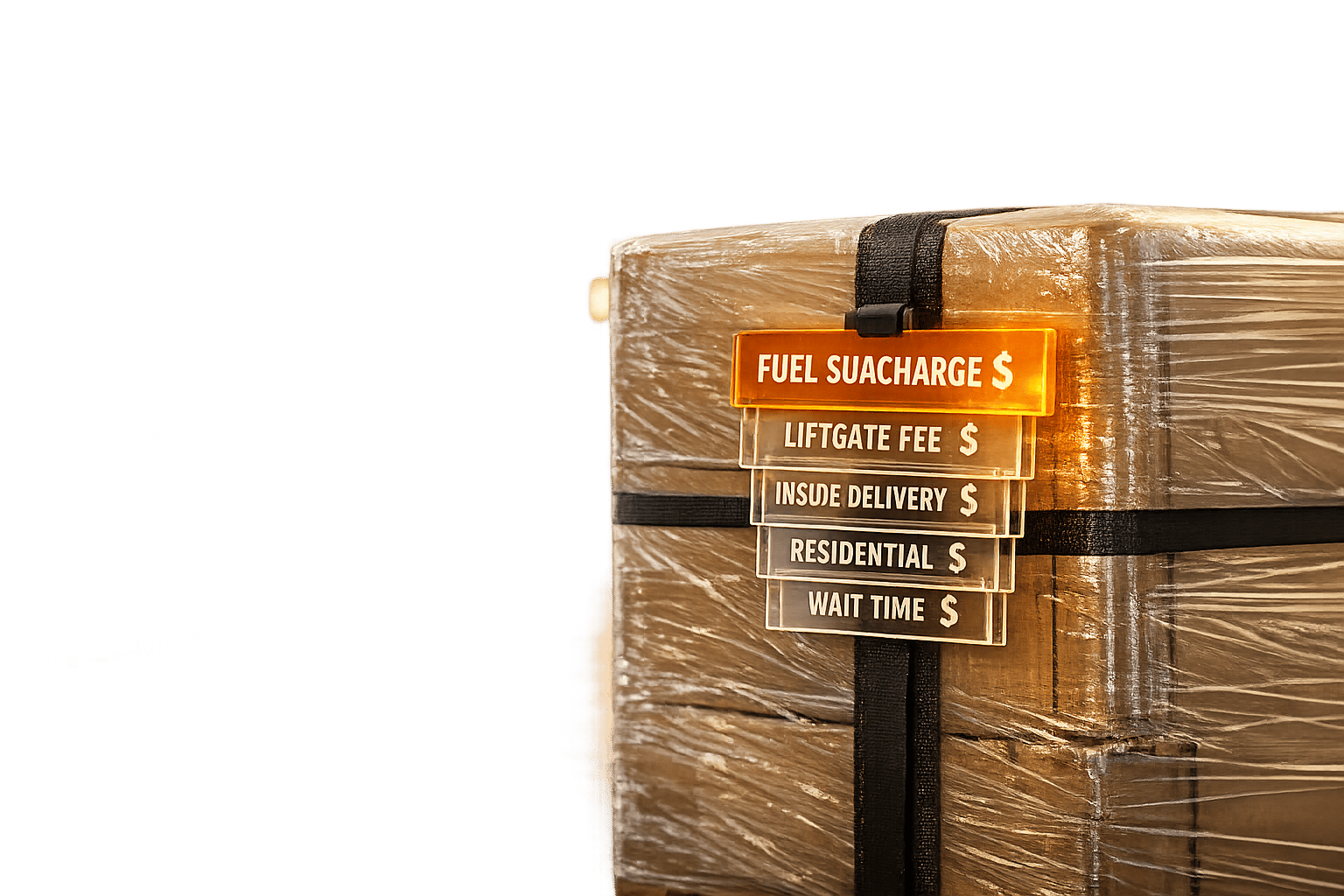
Accessorial charges in shipping are often overlooked but can significantly impact your costs. These fees, which cover additional services like liftgate usage, residential delivery, or reclassification, can inflate your freight bill by 15% to over 50%. Mismanaging them leads to unnecessary expenses.
Key insights:
- Common fees: Liftgate ($50–$150), residential delivery ($75–$175), reclassification ($100s–$1,000s), detention ($50–$150/hr).
- Avoidable costs: Declare accessorials upfront to secure discounted rates and prevent surprise charges.
- Automation tools: Platforms like ShipPeek can help manage, predict, and reduce these fees by up to 15%.
Common LTL Accessorial Charges Explained: Avoid Unexpected Fees
sbb-itb-8138a00
Key Accessorial Charges That Drive Up Costs
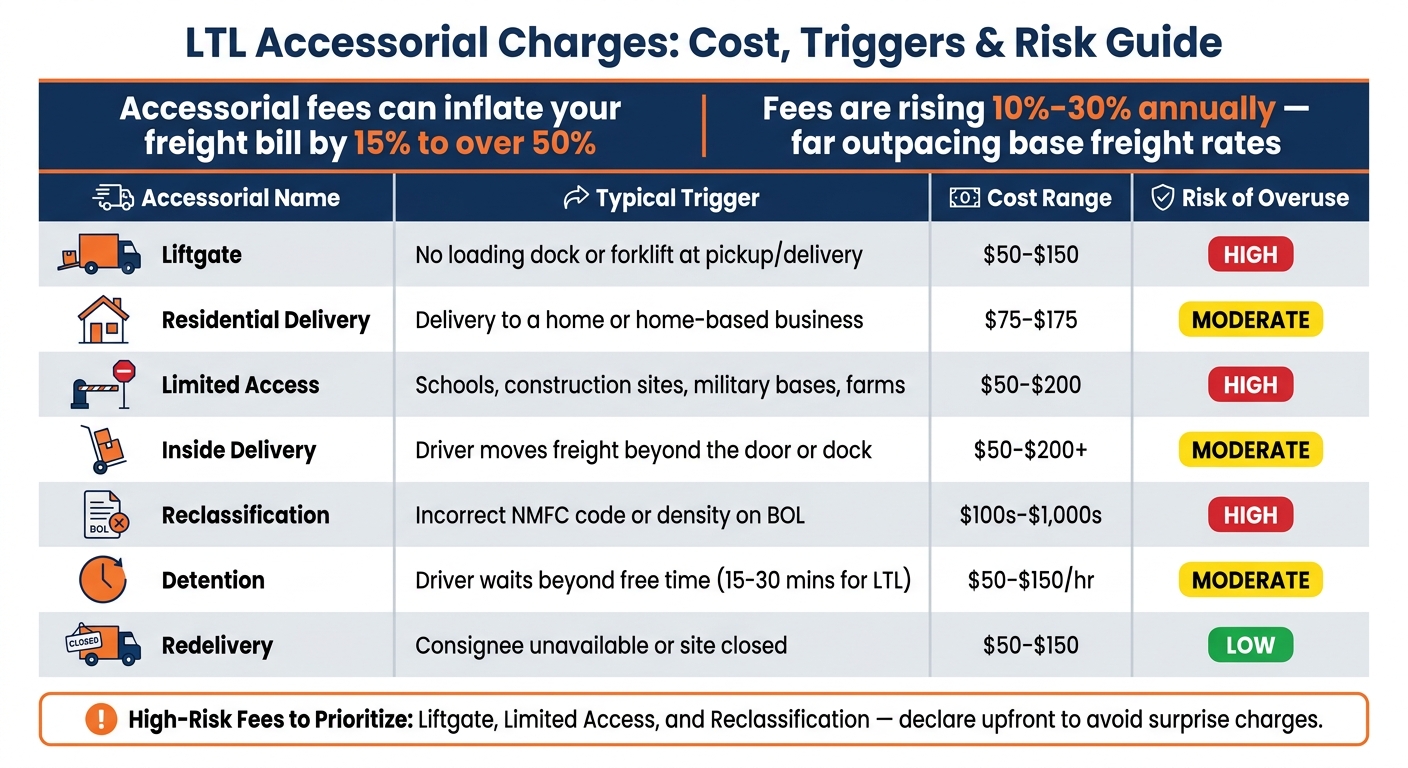
High-Cost Accessorial Types to Know
Accessorial fees can be a mixed bag. Some are straightforward and expected, while others sneak up on you, inflating your shipping bill in ways you might not anticipate.
Take reclassification, for example. This charge pops up when the freight class or density listed on the Bill of Lading (BOL) doesn’t match the carrier’s inspection findings. With the NMFTA’s shift to a 13-tier density scale in July 2025 (Docket 2025-1), getting dimensions right will be more critical than ever. A single error here can tack on hundreds - or even thousands - of dollars [2].
Another common fee is for liftgate service, which costs between $50 and $150 each time it’s used. This charge applies when there’s no loading dock or forklift available at the pickup or delivery site. Similarly, residential delivery fees, ranging from $75 to $175, come into play when freight is delivered to a home or a home-based business. Limited access fees ($50–$200) cover deliveries to places like schools, construction sites, military bases, or farms where standard truck access is tricky. Then there are inside delivery charges ($50–$200+), which apply when a driver has to move freight beyond the curb or dock. These fees can climb further depending on the distance and effort involved.
Detention fees are another costly addition, especially for less-than-truckload (LTL) shipments. Drivers typically start charging detention fees - at rates of $50 to $150 per hour - after just 15 to 30 minutes of waiting at a site [2]. And if a driver can’t complete a delivery because no one is available, the site is closed, or the shipment is refused, redelivery fees of $50 to $150 are added to the bill.
Even when these fees seem predictable, they can cause headaches if applied incorrectly, as the next section explains.
How Misconfigured Accessorials Add Up
When accessorial fees are misapplied, the costs can pile up quickly.
For instance, carriers might automatically tack on liftgate fees without confirming whether they’re needed. The same goes for limited access charges, which can vary widely depending on how each carrier defines a “limited access” location. Without proper verification, you could end up paying for services you didn’t actually require [2].
“If your team cannot predict accessorials, your data packet is not complete.” - SHIPIT Logistics [5]
Adding to the challenge, accessorial fees have been rising by 10% to 30% annually, far outpacing both inflation and base freight rate increases [2]. If left unchecked, these growing fees can significantly inflate your shipping costs.
A Side-by-Side Look at Common Accessorials
Here’s a quick breakdown of some of the most common accessorial fees, including what triggers them, their typical costs, and how likely they are to be overused.
| Accessorial | Typical Trigger | Cost Range | Risk of Overuse |
|---|---|---|---|
| Liftgate | No loading dock or forklift at pickup/delivery | $50–$150 | High; often applied by habit to non-warehouse sites |
| Residential Delivery | Delivery to a home or home-based business | $75–$175 | Moderate; triggered by carrier’s map classification |
| Limited Access | Schools, construction sites, military bases, farms | $50–$200 | High; definitions vary widely by carrier |
| Inside Delivery | Driver moves freight beyond the door or dock | $50–$200+ | Moderate; often requested without shipper’s knowledge |
| Reclassification | Incorrect NMFC code or density on BOL | $100s–$1,000s | High; risk increased by 2025 NMFC density changes |
| Detention | Driver waits beyond free time (15–30 mins for LTL) | $50–$150/hr | Moderate; often caused by poor site coordination |
| Redelivery | Consignee unavailable or site closed | $50–$150 | Low; typically an operational failure |
Knowing what triggers these fees and how much they typically cost can help you avoid unnecessary charges. High-risk fees like liftgate, limited access, and reclassification deserve extra attention. Tightening up how you manage these can lead to fewer surprises and more controlled shipping expenses.
How to Choose the Right Accessorials
Matching Shipment Attributes to Accessorial Needs
Avoid unexpected fees by double-checking shipment details before booking. For instance, does the delivery site have a loading dock? Is it a residential area, school, or construction site? Does the freight exceed 8 feet in length? Overlooking these details can lead to extra charges ranging from $50 to more than $1,000 [2].
To simplify, think of accessorials in three categories: equipment-based (e.g., liftgates for locations without docks), location-based (e.g., residential or limited access fees), and service-based (e.g., inside delivery or scheduled appointments). By gathering key details upfront - such as exact dimensions, total weight (including pallets and shrink wrap), site type, and receiving hours - you can avoid most billing surprises [5].
“Missing accessorials does not eliminate the cost. It only removes your ability to control it.” - Patrick Brenda, LTL Expert [3]
Using Business Rules and Data to Cut Unnecessary Charges
Once shipment details are accurate, use historical data to identify patterns and reduce recurring charges. For example, frequent detention fees may signal issues like understaffed docks or freight not being staged on time. Recognizing these as patterns, rather than isolated incidents, allows you to address the root causes [7].
Meanwhile, carriers today use advanced tools for dimensioning and auditing, making it harder to slip by with incorrect weight or NMFC codes [3][7]. To avoid reclassification fees, use a PCF (pounds per cubic foot) calculator to confirm density before tendering shipments. Don’t forget to include pallet and packaging weight on your bill of lading (BOL), as this is a common trigger for costly adjustments.
“Accessorial management is no longer back-office hygiene. It is freight strategy.” - CXTMS [7]
By turning these insights into formal business rules, you can ensure consistent, accurate charge assessments for every shipment.
Building a Rule Matrix for Consistent Decisions
A simple yet effective way to streamline accessorial management is by creating a rule matrix. This document links specific shipment conditions to the appropriate accessorials, eliminating confusion and ensuring everyone processes orders consistently.
Here’s an example:
| Shipment Condition | Accessorial to Apply | Prevention / Control |
|---|---|---|
| No loading dock or forklift at site | Liftgate | Confirm at booking [5] |
| Delivery to a home or home-based business | Residential Delivery | Auto-tag address in TMS/ERP [5][7] |
| Delivery to school, military base, or farm | Limited Access | Map facility types; apply rule at quoting stage [5] |
| Driver must move freight past the door | Inside Delivery | Confirm with consignee before tender [1][2] |
| Weight or class differs from BOL | Reweigh / Reclassification | Use calibrated scales; include packaging weight [2] |
| Consignee unavailable or site closed | Redelivery | Validate receiving hours and contact info at order time [5] |
The key is to focus on the most relevant charges and ensure the matrix stays updated. Carrier definitions for terms like “limited access” can vary, and tariff structures change over time. Regularly review and adjust your matrix when adding new carriers or modifying shipping lanes [3][2].
How ShipPeek LTL TMS Simplifies Accessorial Management
API-Driven Accessorial Configuration in ShipPeek
Setting up a rule matrix is only half the battle - it’s the enforcement that matters. ShipPeek’s live API integration steps in to bridge this gap. By pulling verified contract rates directly from carrier APIs at checkout, ShipPeek ensures that accessorial charges are accounted for upfront[6]. When booking, the API provides a detailed breakdown that includes the base rate, transit time, service level, and any applicable accessorial fees. This means costs like residential delivery surcharges or liftgate fees are accurately priced before the shipment leaves, rather than surprising you weeks later on an invoice. For Shopify and WooCommerce users, this functionality extends to live rate displays at checkout, giving customers a clear view of final costs. This transparency can reduce billing discrepancies - often caused by estimated rates - by as much as 15% to 30% on LTL shipments[6].
ShipPeek Features That Help Control Costs
ShipPeek connects to over 100 LTL carriers, delivering live quotes in less than two seconds[6]. This speed makes it easier to compare base rates and carrier-specific accessorial fees. Beyond its API-driven pricing, ShipPeek includes several features designed to simplify and refine accessorial management:
| Feature | Benefit for Accessorial Management |
|---|---|
| Live Checkout Rates | Displays verified contract rates upfront, reducing billing discrepancies by up to 30%. |
| Unlimited API Requests | Allows extensive rate comparisons without additional fees. |
| Shipment Templates | Saves recurring lane details to ensure consistent application of accessorials. |
| Unified Dashboard | Offers a single interface to manage and apply carrier rules seamlessly. |
| Freight Analytics | Monitors trends in accessorial spending and carrier performance over time. |
ShipPeek operates on a flat subscription model with no per-dollar freight markup. Plans start at $999 per month, but new subscribers can take advantage of a limited-time offer, reducing the first three months to as little as $749 per month. A 7-day free trial is also available, making it easier to explore these cost-saving features.
Running Cost Scenarios with ShipPeek’s Automation
With unlimited rate requests, ShipPeek users can run “what-if” scenarios to evaluate potential costs before booking. For instance, you can compare liftgate service fees for consignees without a loading dock to avoid unexpected charges. Shipment templates and saved addresses further optimize the process by automatically applying the correct accessorial settings for recurring shipments, reducing manual errors and extra costs. Thanks to enhanced visibility into rates and increased carrier competition, companies using ShipPeek have reported reducing their total freight spend by 8% to 15%[6].
How to Monitor and Improve Your Accessorial Strategy
Keeping a close eye on your accessorial strategy and fine-tuning it is crucial if you want to take full control of your shipping expenses.
Auditing Carrier Invoices for Accuracy
Booking shipments accurately is just the start. Carrier invoices often don’t match the original quotes, and even small errors can add up quickly. Studies show that invoice errors can make up 1%–9% of total charges [10] and occur in up to 10% of freight bills [9]. Considering that accessorials can add 15%–25% to freight costs [8], you can see how unchecked discrepancies can snowball across hundreds of shipments.
The key to effective auditing is a straightforward three-way reconciliation: compare the carrier’s invoice, your shipment record (like TMS data or the bill of lading), and the contracted rate agreement. For charges based on specific events, such as detention or inside delivery, ensure you have supporting documentation like gate timestamps, appointment logs, or signed proof of delivery. If a charge can’t be verified, don’t hesitate to reject it.
| Accessorial Charge | Common Error Type | Verification Source |
|---|---|---|
| Liftgate | Billed when included in contract or not used | Rate Agreement / POD |
| Detention | Incorrect wait time calculation | Gate Timestamps / GPS Logs |
| Residential Delivery | Commercial address misclassified as residential | Address Validation / TMS Data |
| Reweigh/Reclass | Carrier adjustment without supporting evidence | Original BOL / Certified Scale Ticket |
| Address Correction | Fee applied for corrections never performed | Original BOL vs. Delivery Label |
Be mindful of dispute windows. LTL and truckload carriers usually allow 60 to 180 days to dispute a charge, but for parcel service failures, the window can be as short as 15 days [8][10]. Missing these deadlines could mean losing the chance to recover costs.
Metrics to Track Accessorial Performance
Once you’ve identified discrepancies through audits, tracking metrics helps prevent future errors. Start with the quote-to-invoice gap - the difference between the quoted price at booking and the final billed amount. If this gap exceeds 5%, it’s a sign that your booking data for accessorials might need some work.
You should also monitor how much of your total freight spend goes toward accessorial fees. If these charges are growing faster than your base rates, it’s a red flag. Another useful metric is the frequency of reclassification - this can highlight whether carriers are frequently adjusting your freight class, which often points to inconsistencies in your weight or dimension data. Additionally, tracking average detention times by facility can help you identify recurring delays that result in unnecessary costs.
“The most successful LTL shippers treat accessorials with the same level of discipline as base rates: defined, documented, validated, and reviewed regularly.” - Patrick Brenda, LTL Expert, ShipLDI [3]
Here’s a real-world example: In February 2026, a CPG distributor managing 12 carriers and processing around 800 invoices monthly switched from manual spot-checks to fully automated invoice reconciliation. Before automation, their team recovered $18,000 per month by focusing on high-value shipments. After automating the process for all line items, they uncovered 47 discrepancies in a single billing cycle, boosting monthly recoveries to $41,000. Over a year, this change translated to an additional $275,000 in recovered costs [8].
Updating Your Rules as Operations and Carriers Change
Your rule matrix isn’t a “set it and forget it” tool. Carrier tariffs, NMFC classifications, and your operational needs evolve constantly. A rule that worked six months ago could now be quietly racking up extra charges.
To stay ahead, review your accessorial rules at least quarterly [2]. Pay close attention to NMFC updates, as these can reclassify freight you’ve been shipping under the same class for years. For example, the July 2025 NMFC changes under Docket 2025-1 shifted the industry toward density-based classifications [2], making it more important than ever to report dimensions accurately.
Dig into your shipment data to uncover patterns. If certain lanes, facilities, or SKUs consistently trigger the same accessorial charges, it’s not a coincidence - it’s a systematic issue that can be addressed. Another area to watch is fuel surcharges. By early 2026, these surcharges had climbed 26% year-over-year, even though diesel prices only rose by 4.7% during the same period [11]. Such mismatches might signal an opportunity to renegotiate your surcharge tables during your next carrier RFP.
Conclusion: Better Accessorial Choices Lead to Lower Costs
Making smarter accessorial decisions is a straightforward way to achieve long-term savings. These charges can deeply affect your total shipping costs, and if they’re not carefully managed, they can quietly drain your freight budget over time.
The good news? Many of these costs are within your control. By declaring the correct accessorials during tender, keeping shipment data accurate, and auditing invoices regularly, you can avoid unexpected charges. These practices directly support the cost-saving outcomes that tools like ShipPeek LTL TMS are designed to deliver. Taking a proactive approach puts you in the driver’s seat when it comes to managing costs.
Shippers who use accessorial verification tools see real results: billing discrepancies drop by up to 30%, and invoice processing times decrease by as much as 25%[4]. With ShipPeek LTL TMS, live contract rates are pulled directly from carrier APIs, ensuring that the rate you book aligns with the final cost. This kind of live API integration simplifies complex fee structures, and companies using multi-carrier TMS platforms typically lower their total freight spend by 8% to 15% thanks to better rate visibility[6]. Considering that accessorial fees are rising by 10% to 30% annually[2], disciplined processes like clean data management, consistent rules, and routine audits are critical for staying ahead and avoiding unnecessary expenses.
Managing accessorials isn’t a one-time task - it’s a continuous effort. The strategies discussed here, from systematic reviews to disciplined operational habits, are essential for maintaining savings over time. Once these practices become part of your routine, they not only reduce surprise charges but also create a compounding effect on your overall cost savings. Keep refining these processes to consistently drive costs down.
FAQs
Which accessorials are easiest to prevent?
The simplest extra fees to avoid are those linked to location-specific requirements, like limited access delivery, residential delivery, and delivery appointments. By sharing precise details upfront and working closely with carriers, you can sidestep these charges effectively.
How do I avoid reclassification charges in 2025?
To sidestep reclassification charges in 2025, it's crucial to get freight classification right from the beginning. Start by using accurate tools to measure weight and dimensions, and stay informed about any updates to NMFC® guidelines. Always provide complete shipment details, including the correct NMFC codes. Technology can also be a game-changer here. Tools that calculate density and verify freight class can significantly reduce errors. Additionally, teaming up with carriers that double-check classifications before pickup can help you avoid mistakes and cut down on unnecessary fees.
What should I audit when an invoice doesn’t match the quote?
Review charges like liftgate fees, detention fees, and fuel surcharges carefully to ensure they match the terms in your contract. Always check for supporting documents - things like timestamps or delivery receipts can confirm whether these fees are legitimate. If a charge isn’t mentioned in your contract, make sure it’s fully explained and justified. And if it’s not? Contest it. Avoid paying for anything that doesn’t have proper documentation or goes beyond the agreed terms.